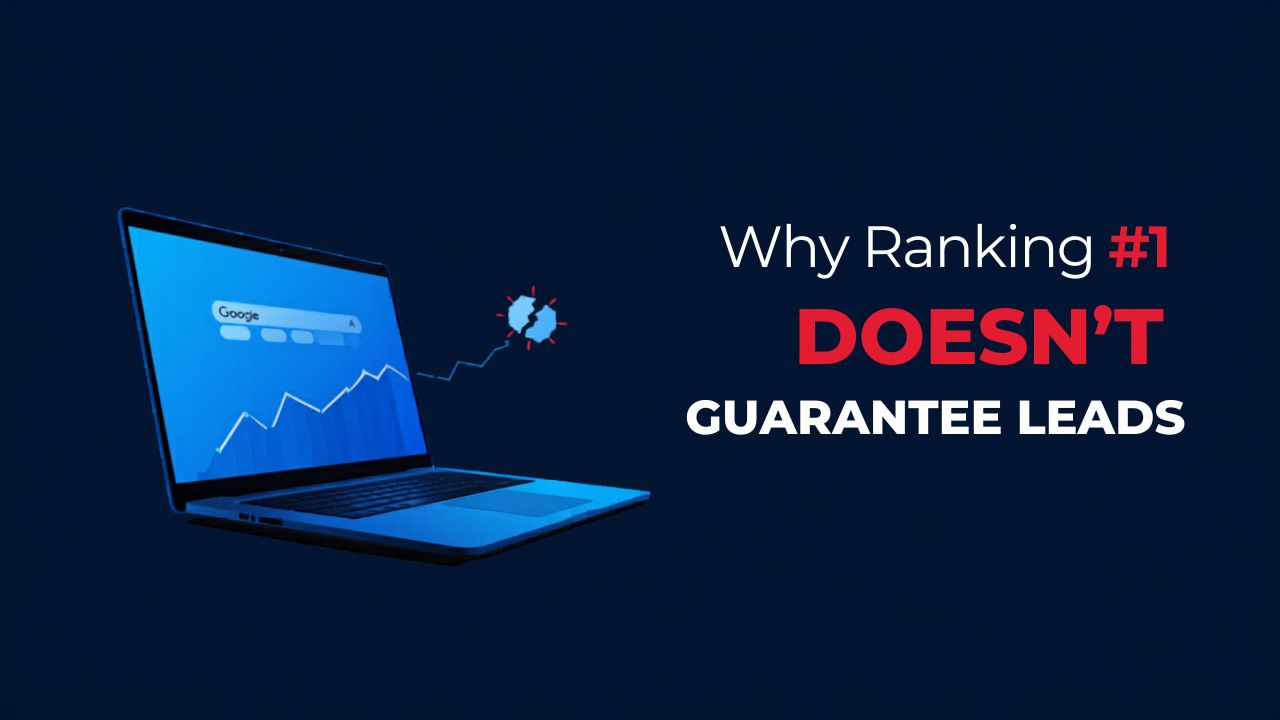
Every week, somewhere in the world, a business owner opens their SEO report, sees their website sitting at position one for a competitive keyword, and waits.
They wait for the inquiries. They wait for the demo requests. They wait for the revenue that was supposed to follow visibility. Most of the time, the wait is longer than anyone told them it would be — and sometimes, the leads never come at all.
Ranking #1 on Google is still treated as the holy grail of digital marketing. It’s a goal repeated in agency briefs, board decks, and growth strategy calls across every industry and market. And it’s the wrong finish line.
This isn’t a contrarian take for the sake of it. It’s the conclusion you reach when you look at what actually separates the brands winning through organic search from the ones producing traffic reports that don’t translate to pipeline. The difference almost never comes down to rankings. It comes down to everything that happens after the click.
The Myth That Ranking Equals Revenue
The logic seems sound. Google dominates global search. Ranking at the top means maximum visibility. Maximum visibility means more customers. It’s the digital equivalent of the best storefront on the busiest street in the city.
Except storefronts don’t close deals. Neither does a ranking.
This myth is durable because of how SEO has historically been sold. The agency pitch is simple: “We’ll get you to page one.” It’s a clean, measurable promise — easy to report, easy to celebrate, easy to invoice against. And so the entire incentive structure of the SEO industry has organized itself around delivering rankings, not revenue.
The business owner gets their position-one keyword. The agency gets renewed. And somewhere in the gap between those two things, the actual question — did this generate growth? — goes unasked.
This plays out across every market and every industry. A B2B software company ranks #1 for a high-volume industry term and sees no meaningful increase in demo requests. An e-commerce brand dominates the first page for its product category but watches conversion rates stagnate at 0.8%. A professional services firm outranks every competitor for its core service keyword and still relies entirely on referrals for new business.
Ranking is visibility. Visibility is not revenue. The gap between those two things is where most SEO strategies quietly collapse.
Why Ranking #1 Still Fails to Generate Leads
If your website is ranking and not converting, the problem is almost certainly one — or several — of the following.
Wrong Traffic Intent
Not all searchers are buyers. In fact, most aren’t.
A company ranking for a broad informational keyword is attracting researchers, students, casual readers, and people who will never be in a position to buy. The keyword has volume. The ranking is real. The traffic is useless to the business.
Search intent is the single most important — and most systematically ignored — variable in SEO strategy. A keyword with 400 monthly searches and clear commercial intent will outperform a keyword with 40,000 monthly searches and informational intent every single time, when measured against leads generated.
The obsession with keyword volume over keyword intent is one of the most expensive mistakes in modern SEO, and it’s endemic.
Poor Website UX and UI
A user who lands on your website and can’t immediately understand what you do, who you serve, and what they should do next will leave within seconds. Google knows this. Rising bounce rates and low engagement signals feed directly back into ranking algorithms — meaning a conversion problem will eventually become a ranking problem too.
Many businesses invest heavily in getting users to their website and almost nothing in what happens when those users arrive. The experience on the other side of the click is where the ROI is actually determined.
Weak Offers and Calls to Action
“Contact Us.” “Learn More.” “Get In Touch.”
These are not calls to action. They’re placeholders. They communicate nothing about what the user will receive, what problem will be solved, or why they should act now rather than later.
Today’s buyers — B2B and B2C alike — are comparison shopping across multiple options before making a decision. If your competitor is offering a free audit, a transparent pricing page, a specific outcome guarantee, or a low-friction entry point into their process — and you’re offering a generic contact form — you will lose the conversion even when you win the ranking.
No Tracking or Analytics Setup
This is the most damaging problem because it makes every other problem invisible. A substantial portion of businesses operating online have either no analytics installed, broken GA4 setups, or tracking configurations that measure vanity metrics (total sessions, pageviews, time on site) without capturing what actually matters: form submissions, phone clicks, purchase completions, scroll depth, content engagement.
Without proper event tracking through Google Analytics 4 and Google Tag Manager, an SEO investment has no feedback loop. You cannot optimize what you cannot measure. You cannot justify budget you cannot attribute. You cannot improve what you cannot see.
Low Trust Signals
Trust is the invisible currency of online conversion. Visitors who don’t know your brand make a judgment call — often within the first few seconds — about whether you’re worth their time and contact details. That judgment is shaped by what they see: client logos, case studies, testimonials, credentials, visible team members, a professional address, social proof of any kind.
Brands that assume their ranking signals credibility are wrong. The ranking gets users to the door. Trust is what gets them to stay, engage, and convert.
Traffic vs. Conversions: What the Numbers Actually Mean
Let’s be precise about this.
Impressions — how many times your website appeared in a search result. Clicks — how many users visited your site from search. Sessions — how many times users engaged with your content. Conversions — how many users completed a desired action: a purchase, a form submission, a call, a registration.
The metric that gets celebrated in most SEO reports is clicks. The metric that builds a business is conversions.
The analogy is simple. Imagine you operate a flagship store in a high-footfall retail district. Every day, 2,000 people walk past your window. That’s your impressions. 300 glance at your display. 80 walk in. But only 3 buy. That’s a 3.75% conversion rate from visitors — which may or may not be acceptable depending on your product. But the more important question is: what’s happening inside the store that’s turning away 77 out of 80 people who were interested enough to enter?
For most businesses, SEO is doing the job of driving people to the window. The conversion problem is inside the store — in the experience, the offer, the messaging, the ease of purchase, the trust environment. And no amount of additional foot traffic will fix a broken in-store experience.
Website traffic vs. leads is the ratio that matters. Everything else is setup.
The Missing Link: Conversion Rate Optimization
Conversion rate optimization (CRO) is the discipline of improving what happens after a user lands on your website. It is, consistently and almost universally, the missing layer in businesses that are ranking but not growing.
Done properly, it involves:
Landing Pages Engineered for a Single Goal A page built to rank and a page built to convert have different structures, different priorities, and different success metrics. An optimized landing page has one audience, one message, and one desired action. Every element on the page either supports that action or it doesn’t belong there.
Messaging That Speaks to Outcome, Not Process Your homepage should not describe what your company does. It should describe what changes for the buyer after they work with you. The shift from feature-focused to outcome-focused messaging is consistently one of the highest-impact conversion improvements available — and it costs nothing to implement.
Trust Architecture Conversion design is trust design. Before someone gives you their contact details, their time, or their money, they need enough evidence that you’re worth it. Building that evidence into the visual and content hierarchy of the page — rather than burying it in a footer or an “About” page — is a discipline.
Performance and Mobile Experience The data on this is not ambiguous. Pages that load in under two seconds convert meaningfully better than pages that take four or five seconds. Mobile users — who represent the majority of traffic across most industries globally — abandon slow, poorly formatted pages at rates that would be alarming if more businesses were tracking them properly.
Speed and mobile optimization are not technical nice-to-haves. They are conversion infrastructure.
Why the SEO Industry Keeps Getting This Wrong
The honest assessment: the SEO industry has a structural misalignment between what it measures and what businesses actually need.
Agencies are incentivized to report what’s easy to measure — keyword positions, domain authority scores, backlink counts, organic session volume. These are real metrics. They’re not irrelevant. But they are inputs, not outcomes. And by optimizing for inputs, the industry has trained an entire generation of business leaders to celebrate the wrong things.
The result is a market full of businesses that are technically “doing SEO” — publishing content, building links, optimizing metadata — with no clear connection between those activities and their actual commercial objectives.
Meanwhile, the businesses that are genuinely winning through organic search have made a different decision. They’ve stopped treating SEO as a standalone channel and started treating it as a component of a broader growth system — one where search intent determines content strategy, content strategy serves the sales funnel, the funnel is tracked end-to-end, and every optimization decision is made against revenue data, not ranking data.
That’s a fundamentally different operation. And most SEO vendors aren’t equipped — or incentivized — to build it.
What a Modern SEO Strategy Actually Looks Like
Effective SEO in 2025 is not a checklist. It’s a system with interconnected components.
Search Intent Mapping Every piece of content should be built around a specific type of searcher at a specific stage of a buying journey. Informational content builds awareness and trust. Commercial content addresses specific problems, comparisons, and objections. Transactional content converts. A coherent strategy covers all three — with each page designed for its role, not just its keyword.
Content That Sells, Not Just Ranks The best-performing content in competitive search environments is content that is so genuinely useful, credible, and specific that readers begin to trust the brand that produced it. Not content optimized for an algorithm. Content optimized for a reader who has a problem and is looking for the best possible answer. When those two things align — and they increasingly do — rankings follow as a consequence, not a goal.
Funnel-Based Architecture Map your keyword strategy to your conversion funnel. Build top-of-funnel content for discovery. Build middle-of-funnel content for consideration and trust-building. Build bottom-of-funnel content for decision and conversion. Structure internal linking to move users naturally from awareness to action. This is content strategy doing the work that a sales team does — at scale, around the clock.
Tracking That Reflects Business Reality GA4 with custom event tracking. GTM deployed properly. Conversion goals tied to real business outcomes — not just sessions and pageviews, but form fills, call initiations, content downloads, product interactions, and purchase completions. If your analytics can’t answer “how many leads did organic search generate this month, and what did they cost?” — your analytics aren’t built for business.
The Reframe Every Business Needs
Stop asking: “Where do we rank?”
Start asking: “What does it cost us to acquire a customer through organic search, and what is that customer worth to us over time?”
That is a business question. That is the question a growth system is designed to answer. And that is the question that reorients an entire SEO strategy — from a ranking game to a revenue engine.
A #1 position on Google is an asset. Like any asset, its value depends entirely on what you’ve built around it. The same ranking can generate zero leads for one business and hundreds for another — and the difference is almost never the ranking itself. It’s the experience, the offer, the trust, the tracking, and the strategy connecting all of them.
SEO as a system — aligned with conversion strategy, built on proper analytics, structured around the buyer’s journey — is one of the most durable, compounding growth channels available to a modern business. SEO as a ranking game is an expensive way to generate traffic reports.
The choice between those two is a strategic one. And it’s one worth making deliberately.
Conclusion: The Ranking Is the Beginning
If your agency is reporting keyword positions as the primary measure of SEO success, ask harder questions.
If you’re investing in SEO and can’t draw a clear line between your organic traffic and your lead volume, the problem is almost certainly not your ranking — it’s everything that comes after it.
The brands genuinely winning through organic search right now aren’t the ones who rank highest in isolation. They’re the ones who’ve built a system where SEO, conversion design, content strategy, and performance tracking operate as a single, coordinated growth engine.
That’s the work worth doing. And it starts with deciding that ranking #1 is not the goal — growth is.
Key Takeaways
- A #1 Google ranking is a starting point, not a business outcome
- Traffic without conversion strategy is a vanity metric with overhead
- Most SEO failures are conversion and tracking failures in disguise
- Search intent — not keyword volume — should drive content strategy
- CRO is not optional; it’s the layer that makes SEO investment defensible
- The right question is not “where do we rank?” but “what does our organic channel cost per lead?”
- SEO works best as a system — connected to your funnel, your analytics, and your commercial objectives
Ready to Find Out What’s Actually Happening in Your Funnel?
If you’re ranking but not converting — or if you can’t clearly attribute your SEO spend to revenue — it’s time for a proper diagnosis.
Dotnp Co offers a free SEO + conversion audit for qualified businesses. We’ll review your search visibility, your analytics configuration, your landing page experience, and your conversion architecture — and give you a clear, honest picture of what’s working and what’s quietly leaking growth.
Request your free audit → dotnp.co
Dotnp Co is a growth systems agency working with global brands — building digital infrastructure that generates measurable, compounding ROI.


What do you think?
Strive to design environments with clarity in mind: Clear instructions, a logical layout, and control over the pace of interactions can all contribute to a more manageable cognitive load.
As designers and developers venture into these new domains, carrying the principles of accessibility forward should be about more than just compliance with guidelines, but rather championing a spirit of inclusivity.